Rust on Your Cast Iron? How to Spot, Stop, and Scrub It Away
I’ve pulled countless skillets from the brink in my workshop, and that first glimpse of orange can be alarming. Rust is a common foe for cast iron, but it’s one you can confidently defeat with some basic know-how.
Based on my years of hands-on restoration, this guide will give you the clear, practical steps you need. Here’s exactly what we’ll tackle together:
- How to quickly identify different types of rust, from surface dust to deeper pitting.
- The safest, most effective methods for removing rust without damaging your pan.
- Simple daily and storage habits that create a lasting barrier against rust.
Key Takeaways for Rust-Free Cast Iron
Rust is simply iron oxide. It’s the chemical reaction that happens when the iron in your pan meets oxygen and water. Think of it like a tiny, destructive fire you can’t see.
Any cast iron that isn’t protected by a layer of polymerized oil (seasoning) will rust. Your pan’s seasoning is its raincoat, its shield, its only defense against the elements.
Managing rust on cast iron comes down to three simple principles you can remember. Fixing and preventing rust on cast iron cookware involves the following steps:
I’ve pulled pans out of barns and basements that looked like science projects. With the right approach, nearly all rust damage is completely reversible, returning your pan to cooking condition.
What Does Rust on Cast Iron Look Like?
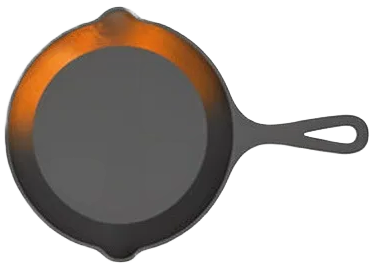
Rust has a specific look and feel. You’ll see orange or reddish-brown flakes, a rough, gritty texture, or a stained, reddish patch. It doesn’t blend in with the black seasoning. It stands out.
This is different from harmless discoloration. Sometimes, especially with new seasoning, you’ll get brownish or black smudges that look uneven. These are just polymerized oil stains and will wipe away with an oiled cloth. Rust will not.
A simple “spot test” never lies: take a dry, white paper towel and rub the suspect area firmly. If you see a distinct orange or red residue on the towel, you’ve confirmed rust.
Rust is opportunistic. It almost always starts in spots where the seasoning is thinnest or has been damaged. Check the cooking surface’s center, the walls just below the rim, and any sharp corners or logos first.
Spotting Rust vs. Discoloration
Understanding this difference saves you from unnecessary work. Rust is destructive and wants to eat your pan. A polymerized oil stain is just a protective layer that looks a little different.
Your fingernail is a great diagnostic tool. Gently run it over the area. Rust will often feel gritty, flaky, or even pitted. A stain will feel as smooth as the surrounding seasoning.
Light Surface Rust
This looks like a faint orange haze or a sprinkling of tiny red-orange speckles across the metal. The texture is often powdery.
Light surface rust is very common and usually the result of leaving a pan damp or storing it in a humid place like under a sink. If you plan to dispose of a rusty pan, removing the rust first makes handling and disposal easier. I see it most often on skillets that were washed and put away without being fully dried.
Deep Pitted Rust
This is more serious. You’ll see concentrated spots of dark orange or reddish-brown. They feel crusty, rough, and sunken into the metal like a small crater.
Deep pitting happens when surface rust is ignored. Moisture works its way deeper into the iron’s pores, and the corrosion expands beneath the surface. It takes more effort to fix, but a pitted pan can still become a fantastic cooker.
Your Step-by-Step Guide to Removing Rust
Finding rust doesn’t mean your pan is ruined. Think of this as a simple restoration project, a chance to give a great tool a fresh start. Follow these clear steps to bring back that smooth, cookable surface.
1. Assess the Damage and Gather Your Tools
First, take a close look. Is the rust a light, dusty film or thick, flaky patches? This tells you how much work is ahead. Before you start, collect your supplies. You likely have most of this at home.
- A stiff nylon brush or a chainmail scrubber.
- Stainless steel wool (grade #0 or #00 is perfect).
- White distilled vinegar.
- Mild dish soap.
- Several clean, dry towels.
Please leave power tools like wire wheels or sanders in the garage; they are too aggressive and can permanently scar the iron’s surface, making it harder to season later. For almost every home cook, elbow grease and the right hand tools are all you need.
2. The Vinegar Soak for Stubborn Rust
For rust that looks caked on or covers a large area, a vinegar bath is your best friend. This directly answers the common “cast iron rust vinegar” search. The acid in the vinegar breaks down the rust so you can scrub it away. Sometimes electrolysis or a targeted manual scrub can be a better fit, depending on the job. We’ll compare electrolysis vs vinegar soak vs manual scrubbing to help you choose the best rust removal method.
- Mix equal parts white vinegar and warm water in a container large enough for your pan or just the rusty section.
- Fully submerge the rusty area. If the pan is too large, you can soak paper towels in the solution and lay them on the rust.
- Set a timer for 30 minutes. Check progress. For very bad rust, you may need up to 60 minutes total.
- Do not walk away and forget it. Leaving bare iron in vinegar for hours can actually etch the metal, making it rough.
3. Scrubbing: From Surface Film to Deep Pits
Now for the satisfying part. Your goal is bare, smooth, silver-gray iron. Any remaining orange or red tint means rust is still present.
For light, dusty rust, start with hot, soapy water and your nylon brush or chainmail scrubber. Scrub in small circles. Rinse and check your progress.
For persistent rust spots or after a vinegar soak, switch to stainless steel wool. Use it with your vinegar solution or soapy water. Scrub firmly. You can also use a specialized “cast iron rust eraser” here-it’s like a dense abrasive block that works wonders on pitted rust. Keep scrubbing, rinsing, and inspecting until the metal is uniformly gray.
4. The Non-Negotiable Dry-Off
This step cannot be rushed. The moment bare, clean iron gets wet, it starts to oxidize. We call this “flash rust,” and it can appear as a faint orange haze in just minutes.
- Immediately after the final rinse, dry the pan thoroughly with a clean towel.
- Place the pan on a stovetop burner over medium heat for 2-3 minutes. Move it around to heat evenly.
- You want the pan to get completely hot to the touch. This drives off every bit of moisture hiding in the pores of the iron.
Your pan is now clean, dry, and ready for its new protective suit of armor.
Bringing Your Pan Back to Life: Re-Seasoning After Rust
Rust removal strips the pan down to bare metal. Re-seasoning isn’t just the next step; it’s how you guarantee the rust won’t come back. This process bonds a layer of polymerized oil to the iron, creating a barrier against moisture and oxygen.
Why Rust and Seasoning Can’t Coexist
Think of it this way: rust is a weed, and your seasoning is the lawn you want to grow. You wouldn’t just throw grass seed on top of a patch of dandelions and expect a healthy yard. You have to remove the weed completely first.
Seasoning needs a clean, solid surface of bare iron to bond to chemically. Rust is a weak, flaky layer of iron oxide. If you try to season over it, the new oil layer will bond to rust, not iron. That weak foundation will eventually flake off, taking your hard-earned seasoning with it and exposing fresh metal to rust again.
The First Oil Coat: Your New Foundation
Start with your warm, dry pan from the drying step. Choose a high-smoke-point oil like Crisco, grapeseed, or flaxseed. Pour a small amount-about a teaspoon for a 10-inch skillet-onto the pan.
Use a folded paper towel to spread the oil over every surface, inside and out, including the handle. Here is the critical part: take a fresh, clean paper towel and thoroughly wipe the pan again, as if you are trying to remove all the oil you just put on. What remains is a microscopically thin, almost invisible layer. This is what polymerizes into a hard finish. A visible wet layer will bake into a sticky, tacky mess.
The Oven Bake: Polymerizing Your Protection
This turns that thin oil film into a hard, protective coating.
- Place your oiled pan upside down on the middle rack of a cold oven. Putting it upside down prevents oil from pooling in the cooking surface.
- Place a sheet of aluminum foil on the rack below to catch any potential drips.
- Heat the oven to 450°F to 500°F (follow your oil’s smoke point guideline). Once heated, bake for one full hour.
- Turn the oven off and let the pan cool completely inside. Removing it while hot can cause the seasoning to crack.
One round creates a base layer. For a durable, rust-resistant finish that behaves like non-stick, repeat this oil-and-bake process 3 to 5 times. I often do this over a weekend. It’s a small investment of time for years of reliable cooking.
How to Keep Rust From Coming Back
Stopping rust for good is about building simple habits. Prevention is always easier than repair.
A consistent routine after every use is your best defense against future rust.
Your Post-Cooking Cleanup Routine
Let’s clear something up right away. It is perfectly fine to use modern dish soap on your cast iron. The old myth comes from a time when soap contained lye, which would strip seasoning. Today’s gentle soaps won’t harm your pan’s polymerized oil layer.
Using soap helps remove food particles and grease. Left behind, that gunk can trap moisture against the iron, creating the perfect spot for rust to start.
My routine is simple:
- Wash with warm, soapy water and a brush or non-abrasive scrubber.
- Rinse thoroughly.
- Dry it completely, right away.
The single most important habit is to dry your pan on the stove. A towel can leave behind tiny droplets of water. Place your clean pan over a low flame or burner for 2-3 minutes until it’s warm to the touch and every bit of moisture has evaporated. I do this with my daily driver skillet every single time.
Smart Storage for Humid Climates
Humidity is the enemy of bare iron. Do cast iron pans rust in storage? They can, if you put them away damp or in a humid, enclosed space. Proper storage is crucial to keep them from rusting.
Always store your pans in a dry, open area with good air circulation. Avoid sealing them tightly in a lower cabinet or putting a lid on a Dutch oven while it’s still holding indoor humidity.
For extra protection, especially in a basement kitchen or coastal home, a simple trick works wonders. Place a folded paper towel inside a Dutch oven or between stacked skillets. This paper towel acts as a cheap humidity sensor and absorber, protecting the iron’s surface. If the towel feels damp, you know the air is too moist, and it’s time to check your pans.
A Little Oil Goes a Long Way
After cleaning and heat-drying, a tiny bit of oil is the finishing touch. This isn’t a full re-seasoning. Think of it as maintenance, like applying a protective wax to a tool.
Pour a few drops of your seasoning oil (like canola or grapeseed) onto the warm pan. Use a paper towel to spread it into an impossibly thin, shiny coat over the entire surface, inside and out. Then, take a fresh, dry paper towel and buff vigorously. Your goal is to buff away any visible oil, leaving only a microscopic layer behind. This step is especially useful before putting a pan into long-term storage.
When to Worry: Is My Rusty Cast Iron Ruined?
Finding rust can feel like a failure. Take a breath. In nearly every case, a rusty cast iron pan is not ruined. It’s just asking for a little attention. I’ve restored pans left in wet leaves for years, and you can too by following these simple steps to remove rust and restore cast iron.
Signs of Minor Damage (Almost Always Fixable)
These are the most common issues, and they have straightforward solutions.
- Surface rust anywhere on the pan. This includes the cooking surface, bottom, sides, or handle. It looks like a dusty orange film or small specks. It scrubs off easily.
- Rust that has settled into small pits, scratches, or the rough texture of the iron. As long as the pit or scratch doesn’t go all the way through the metal, the pan is perfectly salvageable. You’ll just need to scrub a bit harder and re-season.
Signs of Critical Damage (Rare Cases)
True irreparable damage is rare and usually the result of extreme neglect or improper restoration techniques over decades.
- A hole rusted completely through the wall or cooking surface of the pan. Light will shine through it.
- Deep, structural cracks, especially spider-web cracks combined with heavy rust. Cracks cannot be repaired.
- The metal feels alarmingly thin, brittle, or flexible, like it might crumble in your hands. This can happen from overly aggressive sanding or improper electrolysis baths over many years.
If your pan has one of these critical issues, it’s time to retire it. Consider it a lesson learned, not a tragedy.
What About “Rust” on the Cooking Surface?
True rust on the cooking surface is treated exactly the same as rust anywhere else: you scrub it off and re-season. It’s often caused by acidic food sitting in the pan or simmering water for too long, which can break down the seasoning.
Often, what looks like rust on the cooking surface is actually baked-on carbon buildup. This is black, hard, and sometimes flaky. Rust is orange, red, or brown and feels more powdery. If you scrape at a black spot and orange appears underneath, you’ve found rust hiding under carbon. The fix is the same: remove all of it and start fresh with a new layer of seasoning.
The Simple Tool Kit for Rust Management

You don’t need a garage full of specialty gear to manage rust. Your kitchen and a trip to the hardware store can supply everything. I keep my own rust-fighting kit simple: a chainmail scrubber, a bottle of white vinegar, some steel wool, and my trusty oven.
Scrubbing Tools, Ranked by Aggressiveness
Think of these tools like sandpaper grits, each for a different job. Using the right one saves your seasoning and your effort.
- Nylon Brush or Scrubby Sponge: This is your daily driver. Use it for routine cleaning after cooking to wipe away food residue and any light, dusty film that isn’t actual rust. It won’t harm your hard-earned seasoning.
- Chainmail Scrubber: This is my most-used tool for maintenance. It’s fantastic for scrubbing off stuck-on food without damaging the polymerized seasoning underneath. For light surface rust that looks like orange freckles, a good scrub with chainmail under hot water often takes it right off. It provides abrasion without being so harsh that it strips your pan down to bare metal.
- Stainless Steel Wool (Grade #0 or #00): When you see active, fluffy red rust, you need this. It’s for stripping a pan down to bare, clean iron. I avoid regular steel wool because it rusts instantly, shedding little particles that can embed in the iron and cause more rust later. Stainless steel wool doesn’t rust, giving you a clean surface ready for re-seasoning.
Chemical Helpers: Vinegar, Salt, and Baking Soda
Your pantry holds powerful, food-safe solutions. Knowing which to use and when is key.
White vinegar is your main chemical weapon. A diluted soak (one part vinegar to one part water for no more than an hour) loosens rust so your steel wool can wipe it away easily. I use this on pieces I find at flea markets that are fully rusted.
For a very light stain or discoloration that isn’t true rust, a paste of coarse salt and a drop of oil makes a gentle abrasive scrub. It can polish the surface without an aggressive strip. This salt scrub is for maintenance, not for tackling established rust.
Baking soda is excellent for cleaning burnt-on food or neutralizing odors, but it doesn’t react with iron oxide (rust). Save it for general cleaning jobs, not rust removal.
Choosing a Commercial Rust Remover
I see these products on shelves and often get asked about them. My advice is consistent: avoid them for your cookware.
Commercial rust removers are formulated for tools, automotive parts, or industrial metal. They are often too aggressive, can pit the surface of your cast iron, and may leave chemical residues that are difficult to fully rinse away. For the safety of your cookware and your food, manual scrubbing following a vinegar soak is safer, more controlled, and just as effective. For a complete guide on removing rust from cast iron cookware with proven techniques, see the full guide.
If a product is labeled for restoring a rusty wrench or a car bumper, it is not meant for a skillet you’ll cook eggs in. Stick with the simple, proven methods.
Common Questions
Do I need to use vinegar every time I see rust?
No. Vinegar is a tool for stubborn, caked-on rust that doesn’t scrub off easily. For a light, dusty film of surface rust, start with hot, soapy water and a stiff brush or chainmail scrubber. Reserve the vinegar soak for when simple scrubbing isn’t enough.
What is a “cast iron rust eraser” and should I use one?
It’s a dense abrasive block designed to remove rust without metal shavings. It fits between a chainmail scrubber and steel wool in aggressiveness. It’s an excellent, controlled tool for tackling pitted rust spots after a vinegar soak, but it will take your pan down to bare metal, requiring a full re-seasoning afterward.
How can I be sure it’s rust and not just discoloration?
Conduct a simple spot test. Rub the suspect area firmly with a dry, white paper towel. True rust will leave a distinct orange or reddish residue. If the towel comes away clean or with black/gray smudges, you’re likely seeing harmless polymerized oil stains from seasoning.
A Steward’s Mindset for Rust-Free Cast Iron
The most reliable way to protect your cookware is to make heat-drying your pan after every wash an unbreakable habit. This one practice stops rust before it can start by ensuring no moisture is left to attack the iron, keeping your seasoning intact for the long haul. You might also enjoy our deep dives into choosing the right seasoning oil or the step-by-step process for restoring a neglected skillet.
Citations and Authoritative Sources
- r/castiron on Reddit: The rust never comes off completely
- How to Restore and Season a Rusty Cast Iron Skillet – Lodge Cast Iron
- What methods have worked best for removing rust from …
Joseph Gerald
A material science expert by profession, Joseph is also an avid cook. He combines his 10+ years expertise in material science and metallurgy with his passion for cast iron cookware to bring you best hands on advice. His expertise ranges from types of cast iron cookware to best seasoning tips as well as restoration of vintage cast iron utensils. Joe is here to help you solve all your cast iron cookware queries and questions.